Finding the right words can make your writing sound clearer, more professional, and more natural.
The phrase another way to say based on is commonly searched by students, writers, professionals, and content creators who want better alternatives for emails, essays, reports, and everyday conversations.
Sometimes “based on” feels repetitive, especially when you are writing a research paper, preparing a CV, creating content, or communicating at work.
In this guide, you will discover heartfelt, simple, and professional alternatives to “based on,” along with examples you can use in different situations. Whether you need formal phrases, research-friendly expressions, or conversational options, these alternatives will help you express your ideas with confidence.
What Can I Use Instead of Based On?
The phrase “based on” means something is developed, influenced, or created using a particular idea, fact, experience, or source. Choosing the right replacement depends on your sentence and writing style.
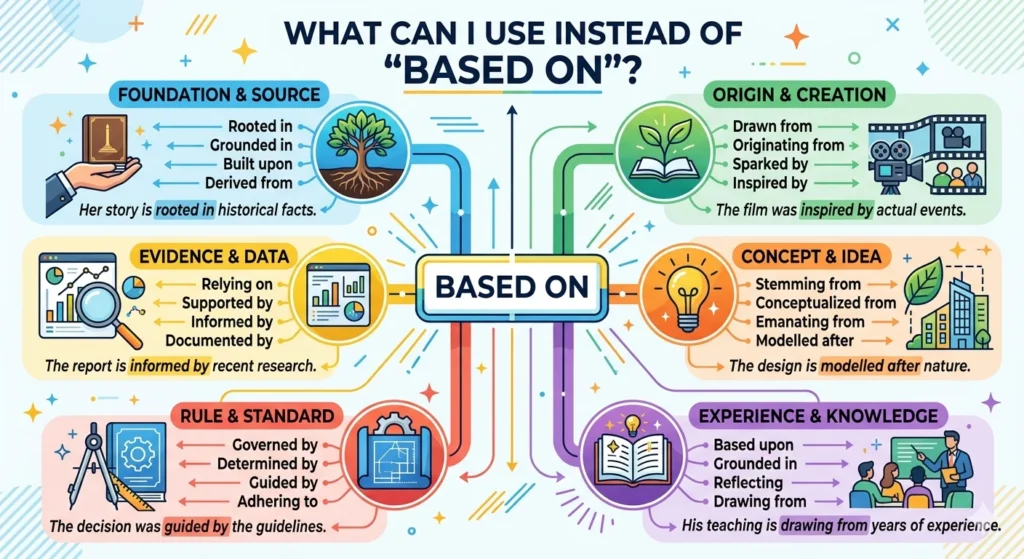
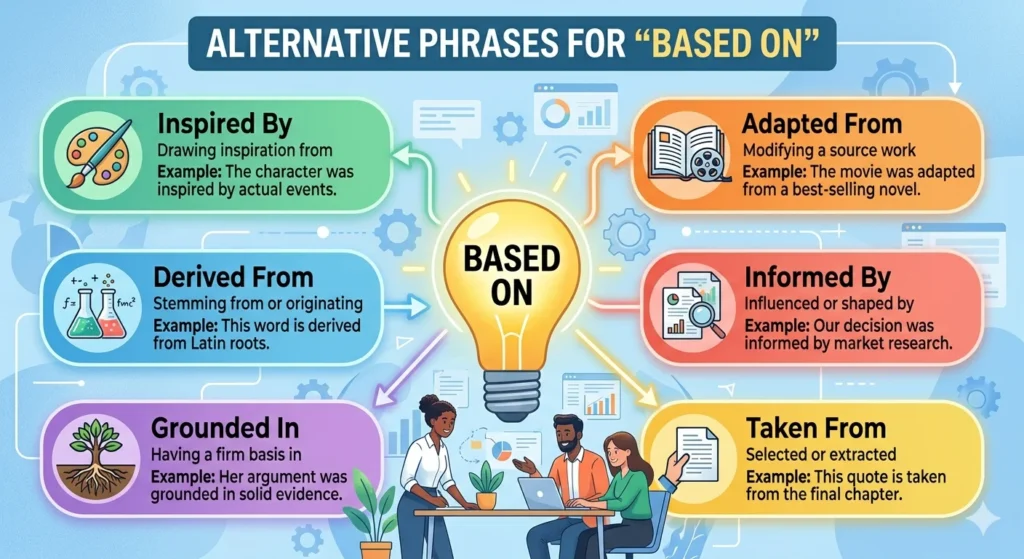
Here are some natural alternatives:
- According to
- Derived from
- Inspired by
- Built upon
- Developed from
- Guided by
- Influenced by
- Supported by
- Founded on
- Drawn from
- Created from
- Related to
- In reference to
- Taking into account
- Considering
Examples:
- Based on recent studies, the results improved.
- According to recent studies, the results improved.
- The article was based on expert opinions.
- The article was developed from expert opinions.
Using different expressions helps your writing feel fresh and avoids repeating the same phrase multiple times.
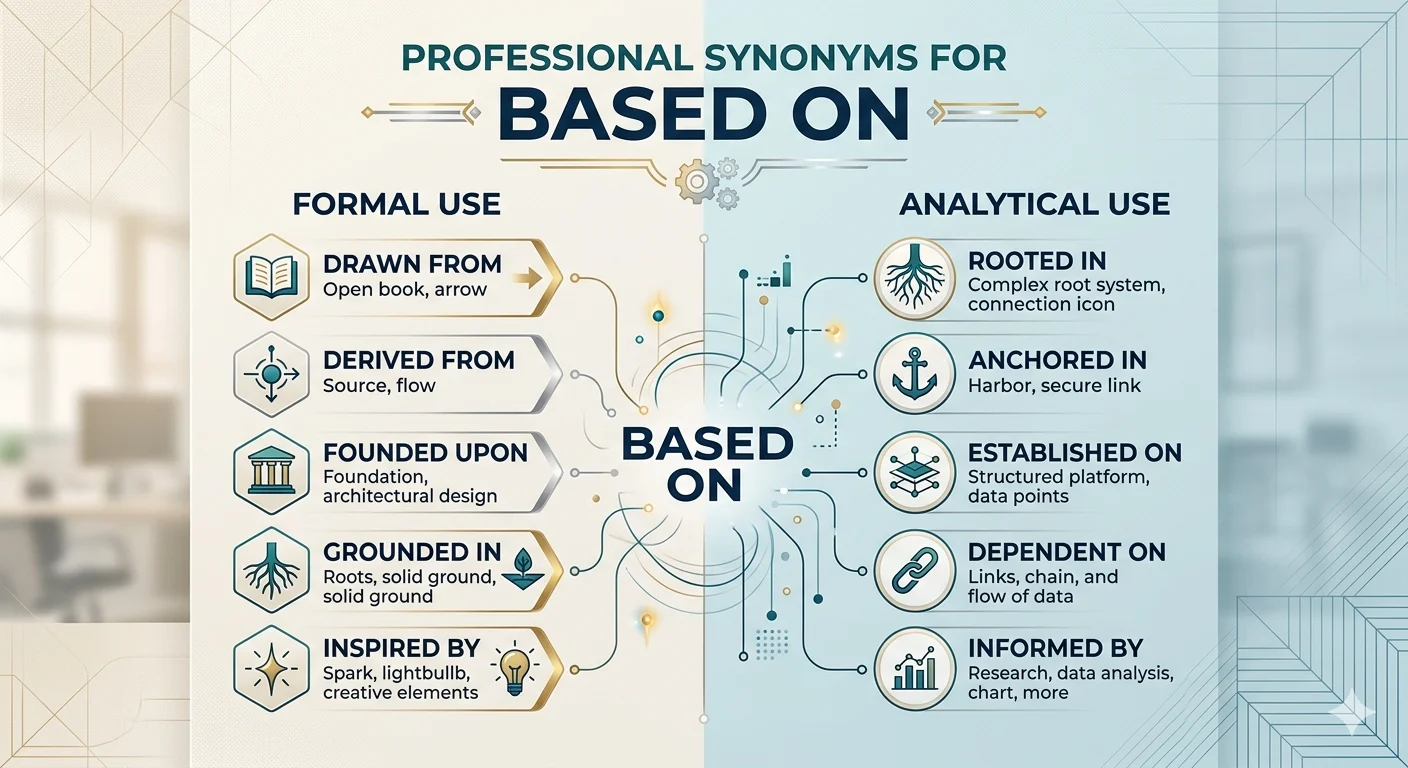
How Do You Say “Based On” Professionally?
In professional communication, replacing “based on” with more polished expressions can make your emails, reports, and presentations sound more confident.
Professional alternatives include:
- According to the available data
- In light of
- With reference to
- As indicated by
- In accordance with
- Supported by
- As demonstrated by
- Derived from
- Guided by
- Following an analysis of
Examples:
- Based on your feedback, we changed the strategy.
- In light of your feedback, we changed the strategy.
- Based on our research, the project will succeed.
- As indicated by our research, the project will succeed.
These phrases work well in business documents, academic writing, and workplace conversations because they sound precise and respectful.
Another Word for Based: Simple Alternatives
The word “based” can have different meanings depending on the context. It may describe location, foundation, ideas, or opinions.
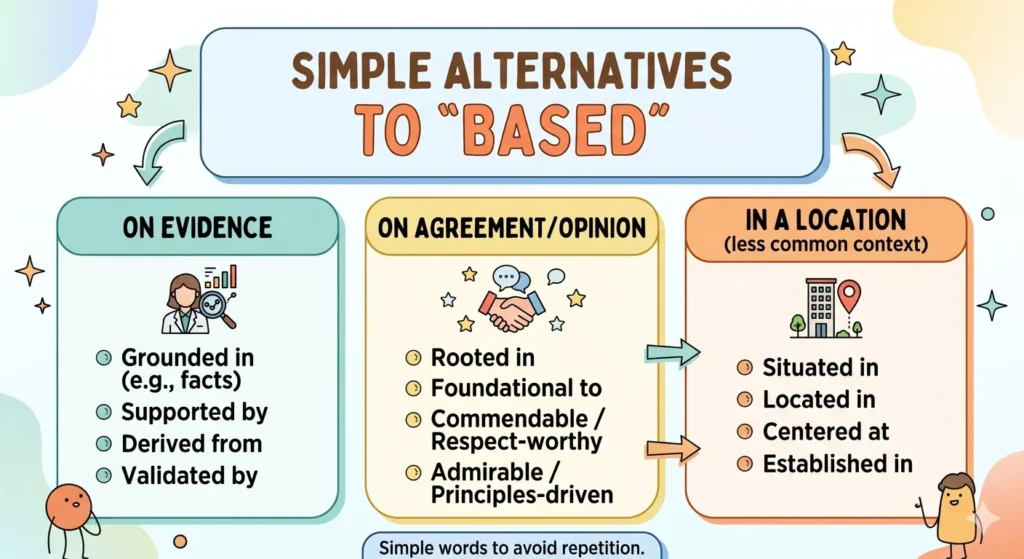
Here are useful alternatives:
- Located
- Established
- Built
- Formed
- Created
- Developed
- Established upon
- Rooted
- Connected
- Centered
Examples:
- The company is based in London.
- The company is located in London.
- The decision was based on facts.
- The decision was supported by facts.
Choosing the right synonym improves clarity and helps readers understand your exact meaning.
Another Word for Based Off in Everyday Writing
Many people use “based off,” but in formal writing, “based on” is usually preferred. Still, there are several alternatives you can use depending on your sentence.
Instead of “based off,” try:
- Inspired by
- Taken from
- Adapted from
- Created from
- Developed using
- Influenced by
- Built around
- Drawn from
Examples:
- The movie was based off a true story.
- The movie was inspired by a true story.
- This design was based off customer feedback.
- This design was developed using customer feedback.
These alternatives sound smoother and more natural in articles, reports, and professional content.
Another Way to Say Based on in a Sentence
Using “based on” repeatedly can make your writing feel less engaging. Here are some examples with different alternatives:
- Based on my experience, teamwork creates better results.
- From my experience, teamwork creates better results.
- Based on this information, we should make a decision.
- Considering this information, we should make a decision.
- Based on the facts, the conclusion is clear.
- Supported by the facts, the conclusion is clear.
- Based on customer reviews, the product improved.
- According to customer reviews, the product improved.
- Based on expert advice, the plan was updated.
- Following expert advice, the plan was updated.
Small changes like these can make your writing sound more professional and reader-friendly.
Based On Synonym Formal for Professional and Academic Writing
Formal writing requires accurate and respectful language. When writing research papers, business documents, or academic assignments, these alternatives can replace “based on.”
Formal synonyms include:
- According to
- In accordance with
- On the grounds of
- As evidenced by
- In consideration of
- Derived from
- Established through
- Supported by evidence
- Confirmed by
- Determined by
Examples:
- Based on the research findings, the theory was accepted.
- According to the research findings, the theory was accepted.
- Based on available evidence, the decision was made.
- As evidenced by available evidence, the decision was made.
These phrases help create a professional tone while keeping your message clear.
Based on Synonym for Research and Reports
Researchers often use “based on” when explaining sources, evidence, or findings. However, academic writing becomes stronger when you use varied expressions.
Useful research alternatives:
- According to the study
- The research indicates
- Evidence suggests
- Findings reveal
- Data shows
- Analysis demonstrates
- Results indicate
- The study highlights
- Research supports
- Observations confirm
Examples:
- Based on research, exercise improves health.
- Research indicates that exercise improves health.
- Based on the collected data, the conclusion was reached.
- Analysis of the collected data led to the conclusion.
These expressions are especially helpful for reports, articles, presentations, and educational content.
Another Way to Say Based on My Experience or Understanding
When sharing personal opinions or knowledge, “based on my experience” and “based on my understanding” are common phrases. Here are better alternatives.

Instead of “based on my experience”:
- From my experience
- In my experience
- Drawing from my experience
- Through my years of experience
- Having experienced this firsthand
- From what I have learned
Instead of “based on my understanding”:
- As I understand it
- From my perspective
- To my knowledge
- From what I have gathered
- As far as I know
- According to my understanding
Examples:
- Based on my experience, communication is important.
- In my experience, communication is important.
- Based on my understanding, the meeting starts tomorrow.
- As I understand it, the meeting starts tomorrow.
These alternatives create a more personal and natural connection with readers.
Another Way to Say Based on This Information
When explaining decisions or conclusions, you can replace “based on this information” with clearer phrases.
Alternatives include:
- Considering these details
- Taking this into account
- Given this information
- In view of these facts
- After reviewing this information
- With this knowledge
- Following this analysis
- Keeping this in mind
- Looking at these details
- From these findings
Examples:
- Based on this information, we changed our approach.
- Taking this into account, we changed our approach.
- Based on this information, the results are positive.
- Given this information, the results are positive.
These phrases work well in conversations, reports, and online content.
CV Ways to Say “Thrive Under Pressure”
When writing a CV, “thrive under pressure” can be expressed in a more professional way. Employers often look for candidates who can stay productive during challenging situations.
Professional alternatives:
- Perform effectively under pressure
- Remain calm in challenging situations
- Deliver results in fast-paced environments
- Adapt quickly to changing priorities
- Manage deadlines efficiently
- Maintain focus under pressure
- Handle complex situations confidently
- Excel in demanding environments
- Work effectively under tight deadlines
- Demonstrate strong problem-solving skills
Example CV sentence:
Instead of:
- I thrive under pressure.
Write:
- Proven ability to deliver high-quality results in fast-paced and challenging environments.
This sounds more professional and highlights your workplace skills.
Frequently Asked Questions
What is another way to say based on?
Some common alternatives for “based on” include according to, derived from, inspired by, supported by, and influenced by.
What does based on mean?
“Based on” means something is created, developed, or decided using a particular source, fact, experience, or idea.
Is “based off” correct?
“Based off” is commonly used in casual speech, but “based on” is usually preferred in formal writing.
What is a formal synonym for based on?
Formal alternatives include according to, in accordance with, supported by evidence, derived from, and as indicated by.
How can I replace based on in research writing?
In research writing, you can use phrases such as research indicates, evidence suggests, findings reveal, and analysis demonstrates.
What is another way to say based on my experience?
You can say from my experience, in my experience, drawing from my experience, or based on what I have learned.
Conclusion
Choosing the right alternative for another way to say based on can make your writing clearer, more professional, and more engaging. Whether you are writing an email, research paper, CV, or online article, the right phrase helps your message connect better with readers.
Small word changes can create a big impact. Use these alternatives naturally, depending on your purpose and audience, and your writing will feel more confident, polished, and authentic.

“Anita Brookner is a creative author at Replyera.com, writing heartfelt wishes, thoughtful replies, and meaningful messages that connect emotions with words.”