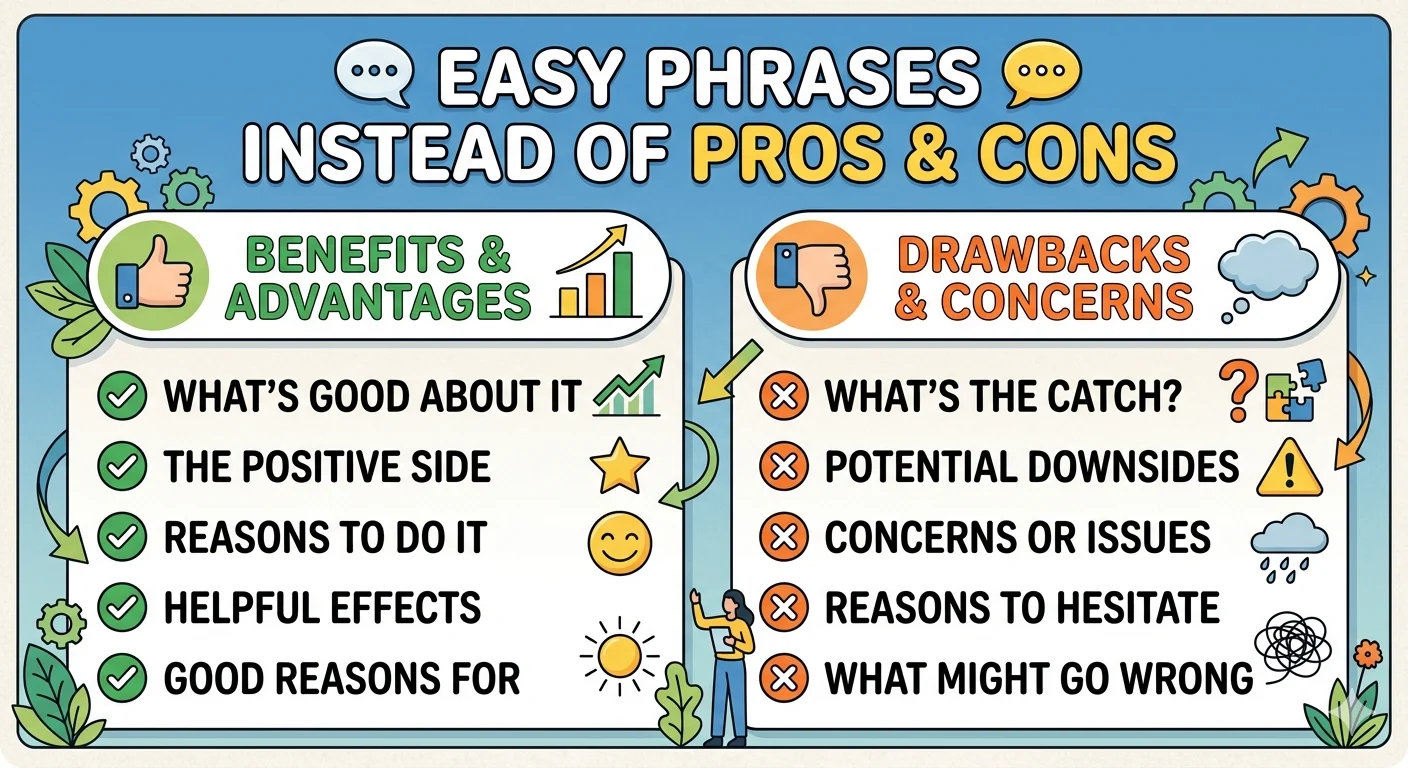
When you’re writing an essay, giving a presentation, or even chatting online, repeating the phrase another way to say pros and cons can start to feel boring.
Maybe you want a more professional tone for work, a simpler phrase for students, or a fresh expression for everyday conversations. The good news is that English offers many natural alternatives that sound smoother, smarter, and more engaging.
In this guide, you’ll discover formal phrases, casual expressions, academic alternatives, and creative synonyms you can use instead of “pros and cons.”
Whether you’re writing an IELTS essay, preparing a business report, or posting on social media, these alternatives will help your writing feel more polished and human. You’ll also learn the meaning, pronunciation, examples, and real-life usage of these expressions in a simple and relatable way.
What Does Pros and Cons Mean?
Before exploring alternatives, it helps to understand the actual meaning.
The phrase “pros and cons” refers to the advantages and disadvantages of something. It’s used when comparing the good and bad sides of a decision, idea, product, or situation.
For example:
- Buying a new phone has its pros and cons.
- Working remotely comes with benefits and drawbacks.
- Every career choice has positive and negative aspects.
The word “pros” means advantages or positive points, while “cons” means disadvantages or negative points.
Interestingly, the phrase comes from the Latin words “pro” meaning for and “contra” meaning against. Today, it’s one of the most common expressions used in discussions, debates, reviews, and academic writing.
Formal Ways to Say Pros and Cons
If you’re writing professionally or academically, these polished alternatives work beautifully.

- Advantages and disadvantages
- Benefits and drawbacks
- Strengths and weaknesses
- Positive and negative aspects
- Opportunities and challenges
- Gains and losses
- Assets and liabilities
- Upsides and downsides
- Favorable and unfavorable factors
- Merits and demerits
- Costs and benefits
- Risks and rewards
These phrases sound more refined in reports, essays, and presentations.
Example sentences:
- Every business strategy has advantages and disadvantages.
- Social media has both benefits and drawbacks for teenagers.
- The proposal includes several strengths and weaknesses.
Many IELTS teachers recommend using varied vocabulary like this because it improves lexical range naturally.
Casual Alternatives for Everyday Conversations
Sometimes formal phrases sound too stiff. In daily conversations, people prefer simpler wording.
Here are some easy and friendly alternatives:
- Good and bad sides
- Highs and lows
- Wins and losses
- The bright side and dark side
- Pluses and minuses
- Good points and bad points
- Trade-offs
- The upside and downside
- Sweet and sour parts
- The best and worst things
Example usage:
- Living alone has its highs and lows.
- Let’s talk about the good and bad sides before deciding.
- Every job comes with trade-offs.
These expressions feel warm, natural, and conversational.
Another Way to Say Pros and Cons in Academic Writing
Students often search for how to formally say pros and cons because repeating the same phrase hurts readability.
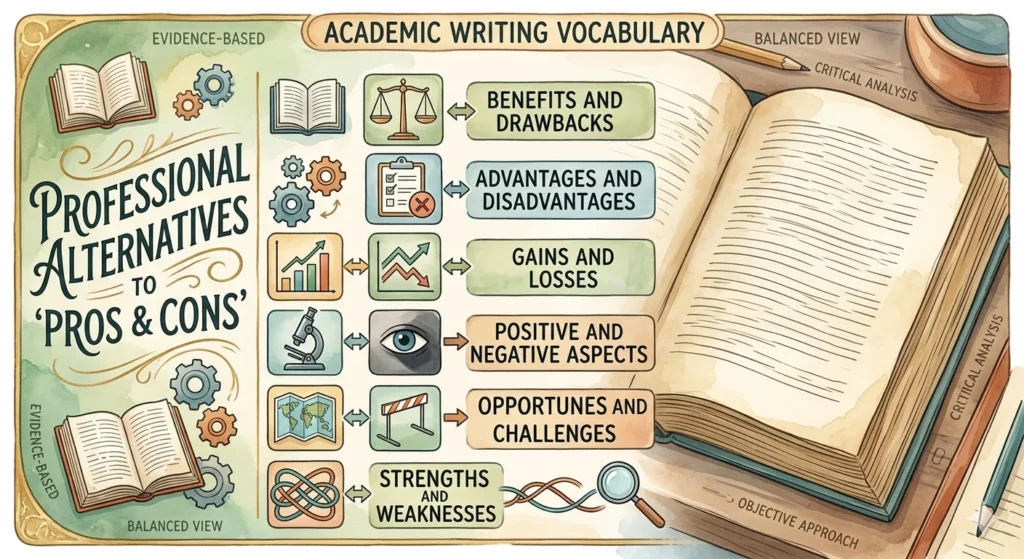
Here are excellent academic alternatives:
- Comparative advantages and disadvantages
- Favorable and unfavorable outcomes
- Positive and negative implications
- Potential benefits and limitations
- Supporting and opposing arguments
- Constructive and adverse effects
- Opportunities versus risks
- Long-term gains and challenges
- Analytical strengths and weaknesses
- Key considerations
Example sentences:
- The study examined the positive and negative implications of online learning.
- Researchers explored the potential benefits and limitations of artificial intelligence.
- The essay discusses supporting and opposing arguments related to globalization.
Academic readers appreciate variety and clarity. Using these phrases naturally improves flow.
Creative Synonyms for Pros and Cons
Want your writing to sound fresh and engaging? These creative alternatives add personality without sounding robotic.
- The good, the bad, and the ugly
- Silver linings and storm clouds
- Roses and thorns
- Sunshine and shadows
- Peaks and pitfalls
- Rewards and risks
- Blessings and burdens
- Boons and banes
- Triumphs and troubles
- Perks and problems
Example sentences:
- Freelancing has its rewards and risks.
- Fame often brings both blessings and burdens.
- Every relationship has roses and thorns.
These expressions work wonderfully in blogs, storytelling, and emotional writing.
Pros and Cons Synonym Formal for Business and Work
Professional communication often requires more polished vocabulary. If you’re writing emails, reports, or presentations, these phrases fit perfectly.

- Strategic advantages and disadvantages
- Business opportunities and risks
- Operational strengths and weaknesses
- Potential gains and losses
- Financial benefits and challenges
- Competitive advantages and limitations
- Key positives and concerns
- Short-term rewards and long-term risks
- Performance strengths and gaps
- Favorable and unfavorable outcomes
Example sentences:
- The report highlights the financial benefits and challenges of expansion.
- We must evaluate the potential gains and losses carefully.
- The strategy offers competitive advantages and limitations.
A recent workplace communication survey found that professionals who use clear and varied vocabulary are often viewed as more confident and persuasive.
Pros and Cons Examples in Real Life
Understanding examples makes these phrases easier to use naturally.
Technology
- Online learning has benefits and drawbacks.
- Smartphones bring convenience but also distractions.
Relationships
- Long-distance relationships have rewards and challenges.
- Marriage comes with strengths and weaknesses.
Career Choices
- Freelancing offers freedom but also uncertainty.
- Remote work has upsides and downsides.
Travel
- Solo travel has exciting opportunities and potential risks.
- Moving abroad includes gains and losses.
Social Media
- Social media provides connection but can increase stress.
- Influencer culture has positive and negative effects.
People across the world now discuss life choices more openly online, especially on platforms like TikTok and Instagram where “pros and cons lists” have become a popular content trend.
Pros and Cons Antonyms and Opposite Expressions
Some readers also search for pros and cons antonyms. While the phrase itself already includes opposites, here are related contrast pairs:
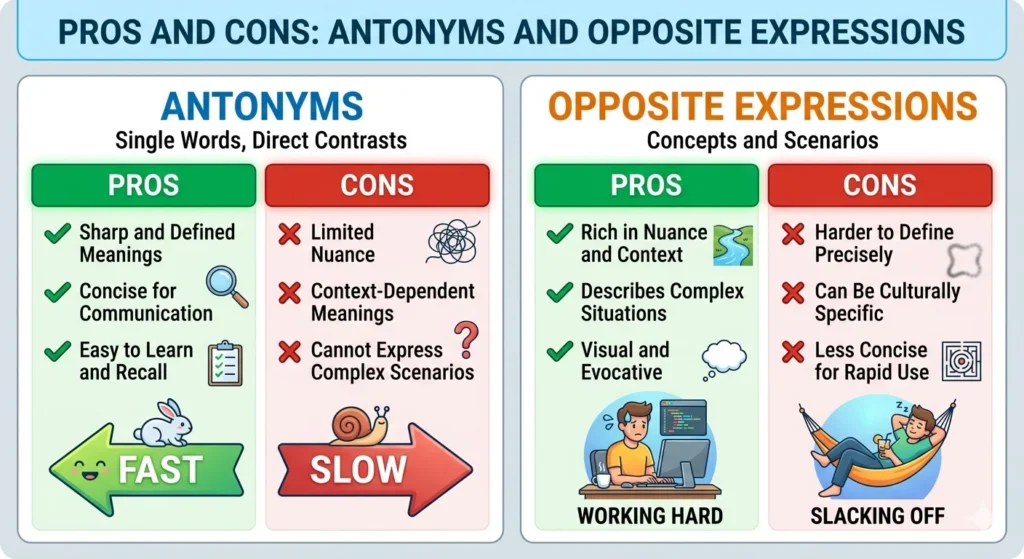
- Success and failure
- Hope and fear
- Rewards and punishments
- Victory and defeat
- Benefit and harm
- Opportunity and danger
- Progress and setbacks
- Profit and loss
- Happiness and struggle
- Support and criticism
These contrasting word pairs help make writing more emotional and expressive.
Example:
- Starting a business can bring both profit and loss.
- Every major decision involves hope and fear.
Advantages and Disadvantages Synonyms IELTS
IELTS students often need vocabulary variety. Instead of repeating “advantages and disadvantages,” try these alternatives:
- Positive and negative effects
- Helpful and harmful impacts
- Benefits and limitations
- Opportunities and obstacles
- Favorable and unfavorable consequences
- Strengths and shortcomings
- Gains and setbacks
- Rewards and challenges
- Merits and demerits
- Constructive and adverse outcomes
Example IELTS sentence:
- Tourism creates economic opportunities but also environmental challenges.
Using natural synonyms improves vocabulary scores without sounding forced.
Short and Simple Alternatives to Pros and Cons
If you want easy phrases that work everywhere, these are perfect.
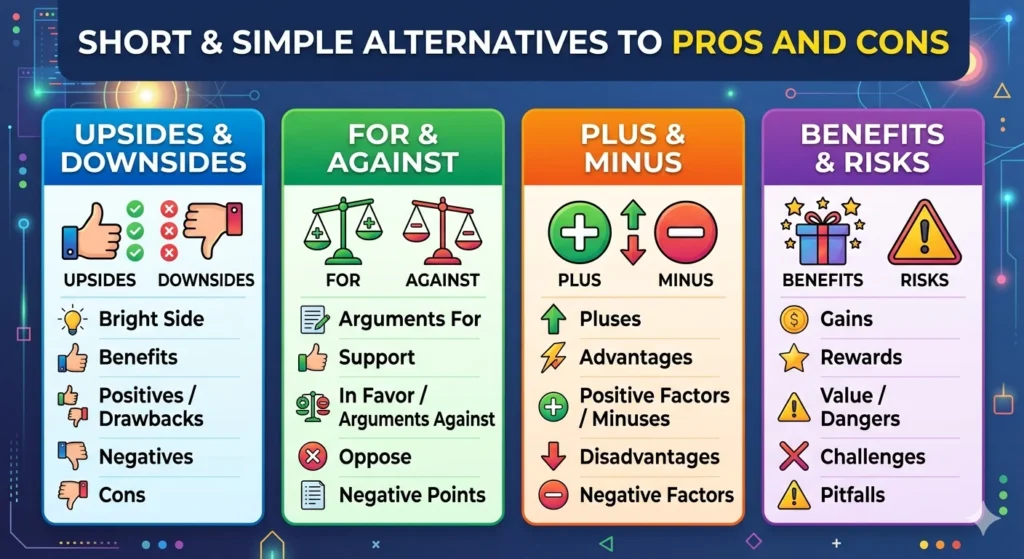
- Good and bad
- Pluses and minuses
- Ups and downs
- Win or lose
- Bright and dark sides
- Better or worse
- Positives and negatives
- Helpful or harmful
- Worth it or not
- Risks and rewards
These simple expressions are easy to understand and sound very human in blogs and conversations.
How to Rephrase Pros and Cons Naturally
Sometimes the best solution is not replacing the phrase directly, but rewriting the entire sentence more naturally.
Instead of:
- Let’s discuss the pros and cons of remote work.
You can say:
- Let’s look at the benefits and challenges of remote work.
- Let’s explore both sides of remote work.
- Let’s compare the positives and negatives.
- Let’s examine what works and what doesn’t.
- Let’s weigh the advantages against the drawbacks.
This approach makes your writing feel smoother and less repetitive.
FAQ About Another Way to Say Pros and Cons
What can be used instead of pros and cons?
You can use alternatives like advantages and disadvantages, benefits and drawbacks, strengths and weaknesses, or upsides and downsides depending on the situation.
How to formally say pros and cons?
Formal expressions include merits and demerits, favorable and unfavorable factors, opportunities and challenges, and costs and benefits.
What is another way to say pros and cons?
Another way to say it includes positives and negatives, trade-offs, rewards and risks, or gains and losses.
What are pros and cons full words?
“Pros” means advantages or positive points, while “cons” means disadvantages or negative points.
How do you pronounce pros and cons?
It’s pronounced as:
- Pros = prohz
- Cons = conz
Together: “prohz and conz.”
What is a good synonym for pros?
Some good synonyms for pros include advantages, benefits, strengths, perks, and positive aspects.
Conclusion
Finding another way to say pros and cons can instantly make your writing sound more natural, professional, and engaging. Whether you prefer formal phrases like “advantages and disadvantages” or casual alternatives like “ups and downs,” the right wording helps you connect better with readers.
Language becomes more powerful when it feels personal and varied. So next time you’re writing an essay, social media caption, business report, or everyday message, try mixing in some of these creative alternatives. Small vocabulary changes can make a huge difference in clarity, emotion, and style.
Keep experimenting with new expressions, and your writing will feel more confident, relatable, and human every time.

“Anita Brookner is a creative author at Replyera.com, writing heartfelt wishes, thoughtful replies, and meaningful messages that connect emotions with words.”