Have you ever been writing something—maybe an essay, an email, or even a caption—and suddenly realized you’ve used “for example” again and again?
It’s a small habit, but it can quietly make your writing feel repetitive and less engaging.
The truth is, learning what is another way to say for example is one of the simplest tricks to instantly improve your writing.
With just a few smart changes, your sentences can sound more natural, professional, and interesting.
In this guide, I’ll walk you through easy, powerful, and real-life alternatives you can actually use. Whether you’re writing for WhatsApp, Instagram, emails, or academic work, you’ll find phrases that fit every situation—plus clear examples so you can use them confidently.
Professional Ways to Say “For Example”
If you’re writing emails, reports, or formal content, the words you choose matter. You want to sound clear, confident, and polished.
Here are some strong professional alternatives:
- For instance
- To illustrate
- As an example
- Namely
- In particular
- Specifically
- As a case in point
- To demonstrate
- One example is
- Consider
👉 Real-life insight:
When I write professional emails, I often use “for instance” because it feels polite and smooth without sounding too heavy.
👉 Example:
Instead of:
“For example, we can improve results by updating the strategy.”
Try:
“For instance, we can improve results by updating the strategy.”
👉 If you’ve ever asked yourself, how do you say “for example” professionally, these options are exactly what you need.
✔ Quick takeaway: These phrases make your writing sound more polished and credible.
👉 Now, let’s move to simpler everyday alternatives.
Simple & Everyday Alternatives (Easy English)
Not everything needs to sound formal. In daily conversation or casual writing, simple words feel more natural and relatable.
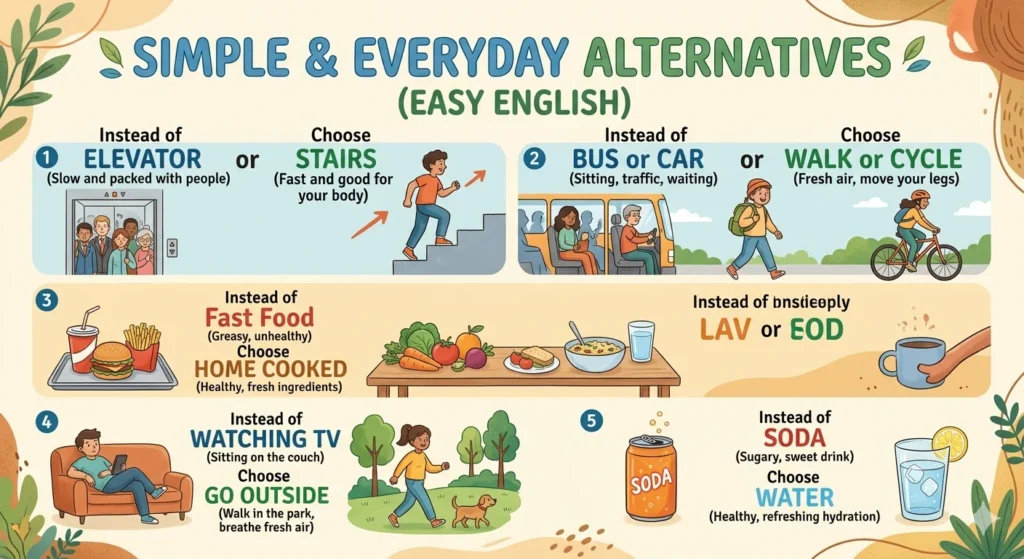
Try these:
- Like
- Say
- Let’s say
- Imagine
- Think about
- Picture this
- Suppose
- Take this
- You could say
- Here’s one
👉 Example:
“Imagine you practice daily—you’ll improve much faster.”
👉 Ever wondered, what can I use instead of “for example”? These simple options work perfectly in daily life.
✔ Quick takeaway: Simple words make your message feel friendly and easy to understand.
👉 Let’s now look at academic writing.
Academic & Essay Synonyms (IELTS Friendly)
If you’re writing essays, especially for exams, repeating the same phrase can affect your impression. Variety shows strong vocabulary and clarity.
Here are powerful academic alternatives:
- For instance
- To illustrate this point
- As evidence
- In support of this
- This can be seen in
- As demonstrated by
- In the case of
- One clear example is
- A good illustration of this is
- Particularly
👉 Example:
“This issue affects many students. For instance, lack of time leads to stress.”
👉 Many students search for for example synonym IELTS or for example synonym essay—these are exactly what examiners expect.
✔ Quick takeaway: These phrases help you score better by improving clarity and style.
👉 Now, let’s make things even shorter.
Short Ways to Say “For Example”
Sometimes you just need something quick, especially while taking notes or writing fast.
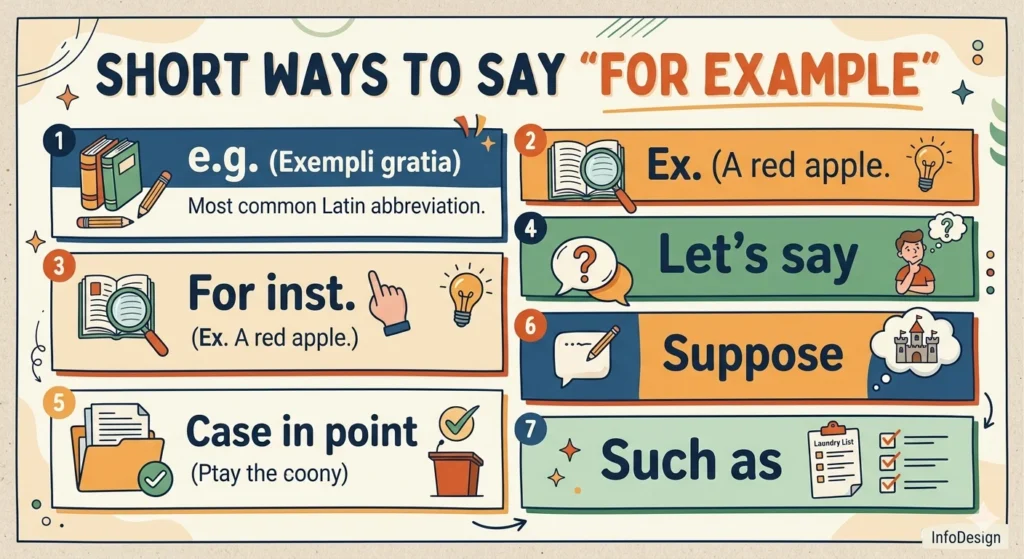
Here are short options:
- e.g.
- eg
- like
- say
- such as
- i.e.
👉 Example:
“Many fruits are healthy, e.g., apples and bananas.”
👉 If you’re thinking, how to say for example in short, “e.g.” is the most effective and widely used option.
✔ Quick takeaway: Short forms save time while keeping your writing clear.
👉 Now let’s make your writing more engaging.
Creative & Engaging Alternatives (Make Writing Interesting)
Ever noticed how repeating the same phrase makes your writing feel boring? That’s where creative alternatives help.
Try these:
- Picture this
- Imagine a situation where
- Think of it this way
- Let me explain with a simple example
- Here’s something interesting
- Consider this scenario
- You might notice
- Let’s look at this
- A great example would be
- Take a moment to think about
👉 Example:
“Picture this—you finish your work early and feel relaxed all day.”
👉 If you’re asking what is another way to say for example in a sentence, these options make your writing feel alive.
✔ Quick takeaway: Creative phrases make your content more engaging and memorable.
👉 Let’s now improve how you start sentences.
Alternatives to Start a Sentence
Starting every sentence the same way can feel repetitive. A small change can make your writing smoother.
Try these:
- For instance
- To illustrate
- Consider this
- One example is
- Specifically
- In particular
- Let’s take
- As an illustration
- A good case is
- To begin with an example
👉 Example:
“Consider this: small habits can lead to big success.”
👉 This solves a common question: another word for for example to start a sentence
✔ Quick takeaway: Better sentence starters improve flow and readability.
👉 Now, what if you want to give more than one example?
What Can I Say Instead of Another Example?
When you’re adding more examples, repeating the same phrase can feel awkward.
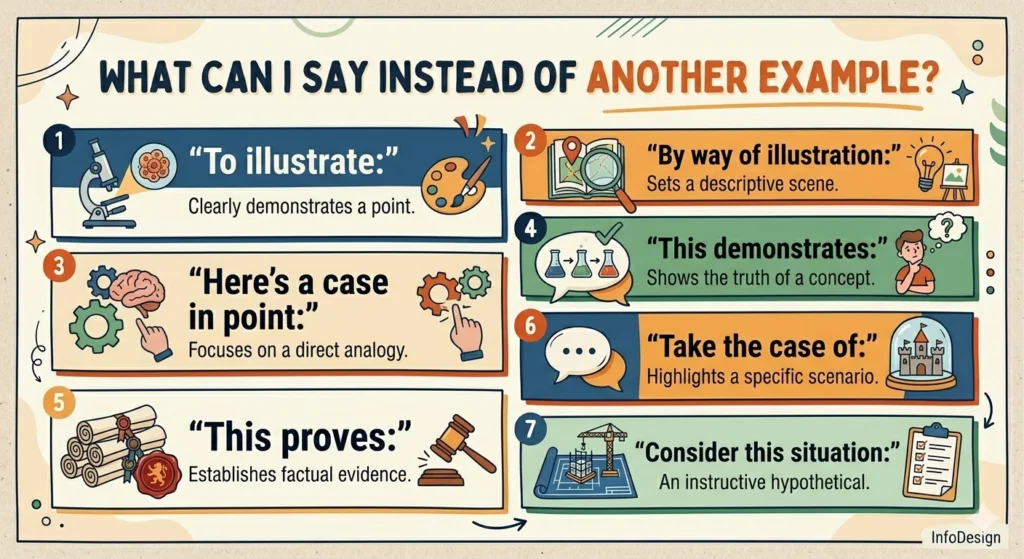
Here are better options:
- Another instance is
- Similarly
- Likewise
- A further example is
- In addition
- Also
- Another case is
- One more example is
- Additionally
- Beyond this
👉 Example:
“Similarly, regular exercise improves mental health.”
👉 This directly answers: what can I say instead of another example?
✔ Quick takeaway: These phrases help your writing flow smoothly without repetition.
Meaning of “For Example” (Simple Explanation)
Let’s keep it simple.
“For example” is used to explain or support your idea with a clear situation.
You use it when:
- You want to make something clear
- You want to give proof
- You want the reader to understand better
📊 Interesting fact:
Content with examples is easier to understand and remember. That’s why strong writers always use them—but in varied ways.
👉 So learning what is another way to say for example is a small skill with a big impact.
✨ Pro Tip: Instantly Improve Your Writing
Here’s a simple but powerful trick:
👉 Every time you write “for example,” try replacing it every second time with a different phrase.
This small habit can instantly boost your writing and make it feel more natural, smart, and professional.
FAQs (Frequently Asked Questions)
What can I use instead of “for example”?
You can use “for instance,” “such as,” or “to illustrate.” For example, in a sentence, “for instance” works well in both formal and casual writing.
How do you say “for example” professionally?
You can say “for instance,” “namely,” or “to illustrate.” These sound more polished in emails and reports.
What is another way to say for example in English?
Common alternatives include “for instance,” “like,” and “such as,” depending on your tone.
What is another way to say for example in a sentence?
You can say “consider this,” “imagine,” or “picture this” to make your sentence more engaging.
What is another way to say in other words?
You can use “in simpler terms,” “to put it differently,” or “basically.”
How to say for example in short?
The most common short form is “e.g.”
Conclusion
Now you understand that what is another way to say for example is more than just vocabulary—it’s a powerful way to improve your communication. Small changes like these can make your writing clearer, more engaging, and more professional.
Start using these alternatives today and notice the difference. Your writing will feel smoother, your ideas will connect better, and your message will become more impactful. Keep practicing, keep experimenting, and most importantly—write in a way that feels natural and truly you.

“John Williams is a skilled author at Replyera.com, sharing meaningful wishes, smart replies, and engaging messages that express emotions clearly and warmly.”