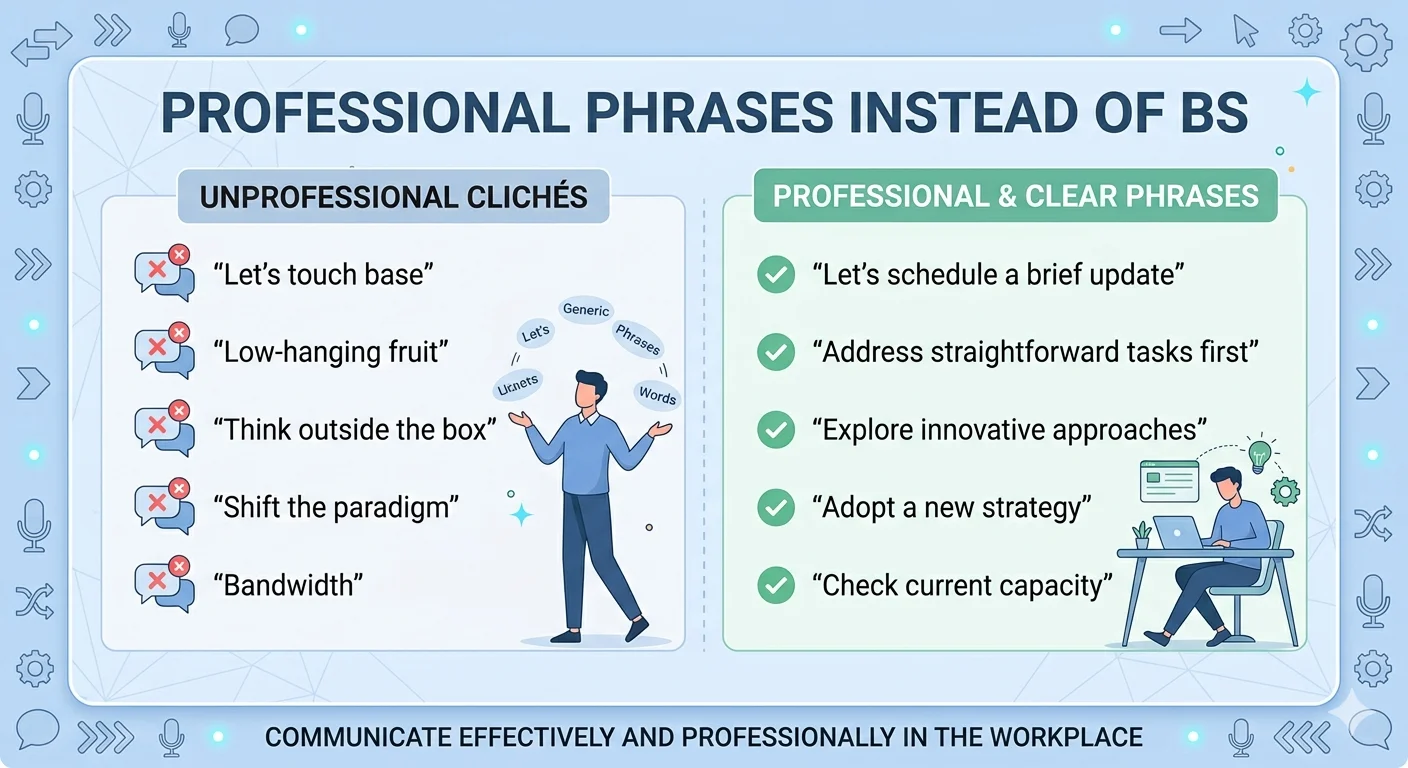
Have you ever heard someone say something that sounds completely wrong, exaggerated, or impossible, and the first word that comes to mind is “BS”?
While this phrase is common in casual conversations, it is not always the best choice in professional or respectful situations. Knowing a professional way to say BS helps you express disagreement without sounding rude or aggressive.
In this guide, you will discover polite alternatives, workplace phrases, email-friendly expressions, and everyday replacements that fit different situations. Whether you are writing a business email, responding on social media, or having a personal conversation, these thoughtful phrases will help you communicate your ideas clearly while maintaining respect.
What Is a Professional Way to Say BS?
The phrase BS is commonly used when someone wants to describe something as false, exaggerated, unreasonable, or meaningless. Although it is widely understood, it can sound informal or offensive in certain situations.
A more professional approach is to explain why something seems incorrect instead of simply labeling it.
Here are some respectful alternatives:
- This information appears inaccurate.
- This statement may not be completely correct.
- The claim requires additional evidence.
- I have concerns about the accuracy of this information.
- This explanation seems unclear.
- The details provided do not match the available facts.
- This argument lacks sufficient support.
- This conclusion may need further examination.
- The statement appears misleading.
- I believe this point needs more clarification.
Using professional language shows maturity and keeps conversations focused on solving problems rather than creating arguments.
A good communicator does not only point out problems; they explain concerns in a way that encourages discussion.
Professional Way to Say BS in Email
Emails require careful wording because the reader cannot hear your tone of voice. A sentence that sounds harmless in conversation may appear disrespectful when written.
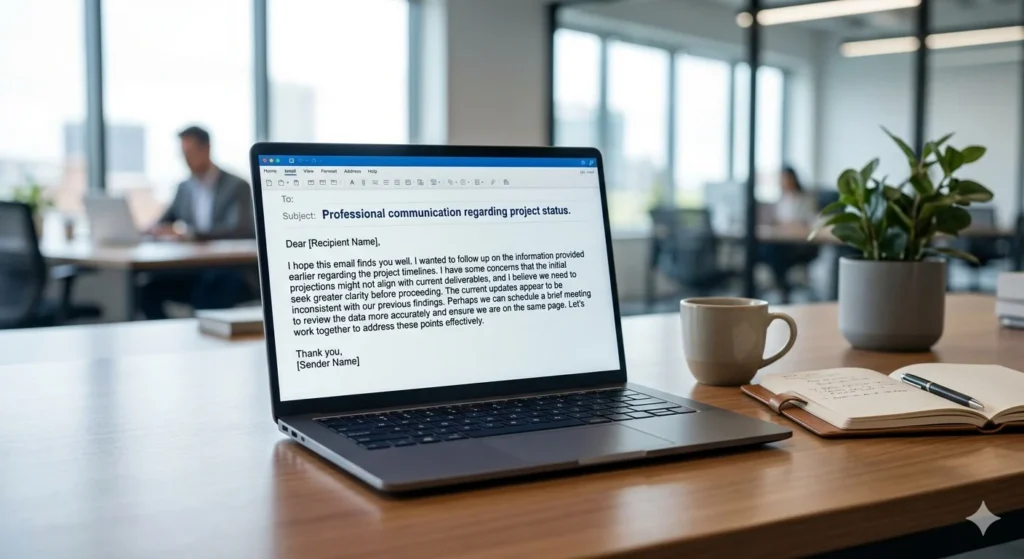
If you want to express that something seems incorrect in an email, try these alternatives:
- I would like to request further clarification on this matter.
- I have some concerns regarding the accuracy of this information.
- Could you please provide additional details to support this statement?
- The information provided seems inconsistent with previous findings.
- I believe this point requires additional review.
- There may be some misunderstanding that needs to be addressed.
- This conclusion does not appear to reflect the available information.
- I would appreciate more context regarding this decision.
- The current explanation leaves some questions unanswered.
- This information may need further verification.
For example:
Instead of writing:
“This report is BS.”
You can write:
“This report contains several points that may require additional verification.”
The second sentence sounds professional while still making your concern clear.
Using respectful language is especially important when communicating with clients, managers, coworkers, or customers.
Professional Alternatives to BS for Workplace Discussions
Workplace conversations often require honesty, but the way you deliver your message matters. A respectful disagreement can lead to better ideas and stronger teamwork.
Here are some workplace-friendly replacements:
- I see some challenges with this approach.
- This idea may need more supporting information.
- I am not fully convinced by this explanation.
- The reasoning behind this decision is unclear.
- This proposal may not address the main concern.
- There are some areas that need improvement.
- This strategy may not be practical.
- I believe we should reconsider this point.
- The evidence does not fully support this conclusion.
- This assumption may need further investigation.
- The argument appears incomplete.
- More information is needed before making a decision.
These phrases help you disagree professionally without creating unnecessary tension.
In modern workplaces, employees are often encouraged to question ideas and share different opinions. Clear communication helps teams make better choices.
Another Word for BS: Professional Synonyms
The best replacement depends on what you actually mean. BS can describe many different situations, including false information, exaggeration, or meaningless talk.
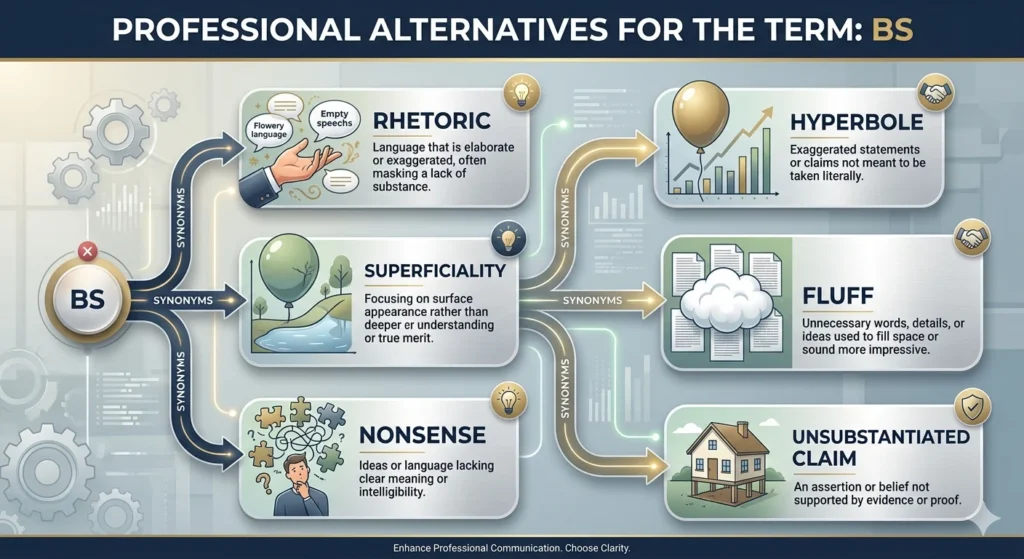
Here are some useful synonyms:
If you mean something is false:
- Incorrect
- Untrue
- False
- Inaccurate
- Misleading
- Fabricated
- Unverified
- Incorrectly presented
If you mean something is nonsense:
- Absurd
- Illogical
- Ridiculous
- Unreasonable
- Senseless
- Meaningless
- Pointless
- Baseless
If you mean someone is exaggerating:
- Overstated
- Exaggerated
- Inflated
- Unrealistic
- Misrepresented
- Overdramatic
If you mean something is poor quality:
- Weak
- Ineffective
- Unreliable
- Unsatisfactory
- Poorly supported
Choosing a specific word makes your communication stronger. Instead of saying “That is BS,” explaining the exact issue creates a more meaningful conversation.
How Did BS Become Slang?
The term BS became popular as a shortened version of the word “bullshit,” which has been used in English for many years to describe nonsense, deception, or exaggerated statements.
Over time, the abbreviation became common because it sounded less harsh than saying the complete word. People started using BS in casual conversations, entertainment, online discussions, and social media.
Today, you may see phrases like:
- “That sounds like BS.”
- “I don’t believe that BS.”
- “Stop spreading BS.”
The expression is especially common online because people often use short phrases when commenting on posts or discussions.
However, language changes depending on the environment. The same phrase that works among friends may not work in a professional setting.
For example:
A friend might say:
“That story is BS.”
A professional response might be:
“I question the accuracy of that information.”
Both sentences express doubt, but the second one sounds more respectful.
Is It Okay to Say BS?
Whether saying BS is acceptable depends on where and with whom you are speaking.
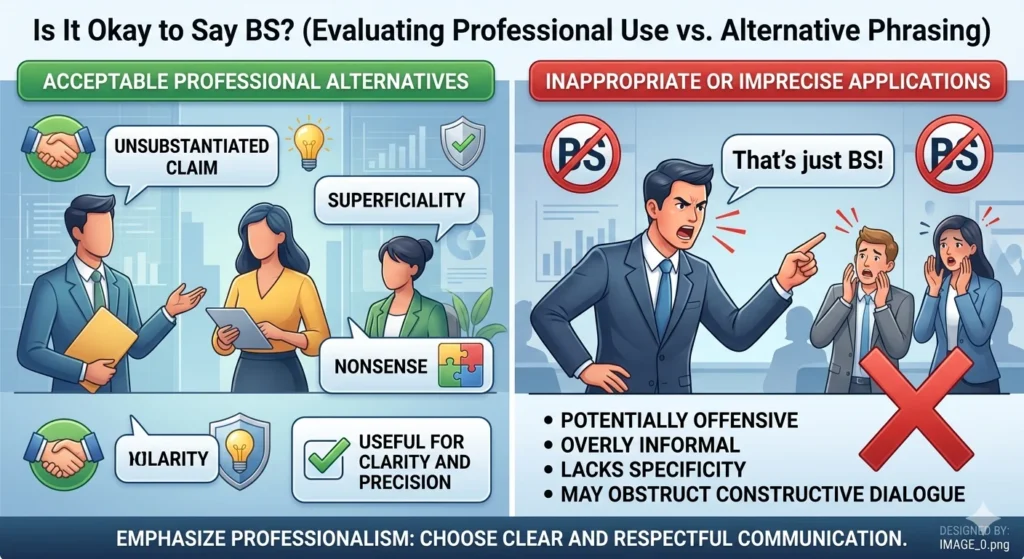
In casual situations, many people use BS without thinking twice. Friends may use it jokingly or when expressing frustration.
Examples:
- “That excuse is BS.”
- “This is complete BS.”
- “I call BS on that.”
However, it may not be suitable in:
- Workplace meetings
- Formal emails
- Interviews
- Academic writing
- Customer service conversations
In professional communication, people usually prefer clearer words.
Instead of:
“That idea is BS.”
Try:
“That idea may not be supported by enough evidence.”
Instead of:
“This excuse is BS.”
Try:
“This explanation does not seem convincing.”
Professional communication is not about avoiding disagreement; it is about expressing disagreement in a productive way.
What Is the British Word for BS?
British English has many colorful alternatives for BS. Some are serious, while others sound humorous.
Common British expressions include:
- Nonsense
- Rubbish
- Hogwash
- Tosh
- Codswallop
- Drivel
- Claptrap
- Baloney
- Garbage
The word “hogwash” means foolish or meaningless talk. It is often used in a playful way.
Examples:
- “That idea is complete hogwash.”
- “Don’t listen to that rubbish.”
- “That explanation is nonsense.”
British speakers often choose softer expressions depending on the situation. Some words can show disbelief while still keeping the conversation light.
BS Meaning in Relationships
The meaning of BS can change when it is used in relationships. In personal conversations, people often use it when they feel someone is being dishonest, avoiding responsibility, or not being genuine.
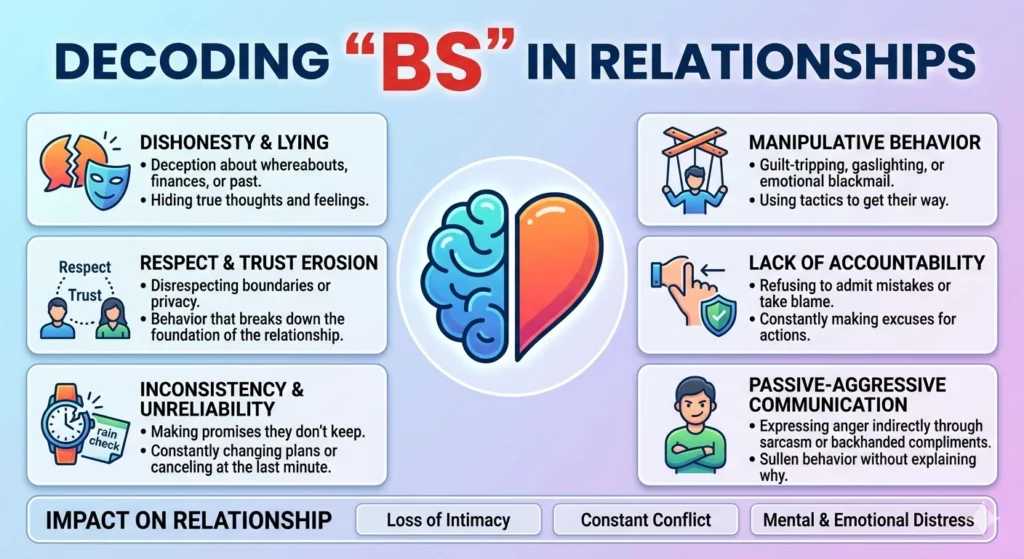
For example, someone might say:
- “I feel like you are giving me BS.”
This usually means:
- I feel you are not being honest.
- I think something is being hidden.
- Your explanation does not feel believable.
However, using harsh words during emotional conversations can make problems worse.
Instead of saying:
“You are full of BS.”
A healthier approach may be:
- “I feel like I am not getting the complete truth.”
- “I need more honesty from this conversation.”
- “Something about this explanation does not feel right.”
Open communication helps relationships grow stronger because both people feel heard.
Funny Alternatives to BS
Sometimes people use BS in a joking way. If you want a funny or playful alternative, these expressions can work:
- Nonsense
- Baloney
- Hogwash
- Fairy tales
- Made-up stories
- Creative storytelling
- Pure imagination
- A tall tale
- A little suspicious
- A questionable masterpiece
Funny phrases can make conversations lighter without sounding too negative.
For example:
“That sounds like a very creative explanation.”
or
“That story belongs in a comedy show.”
Humor can be a friendly way to express doubt while keeping the mood positive.
Synonym for Bsing
The phrase “BSing” usually means pretending, exaggerating, joking around, or talking without serious information.
Professional alternatives include:
- Making unsupported claims
- Exaggerating
- Misleading
- Avoiding the truth
- Speaking without evidence
- Making excuses
- Giving inaccurate information
- Being unclear
- Speculating
Casual alternatives include:
- Messing around
- Making things up
- Talking nonsense
- Fooling around
- Stretching the truth
The best choice depends on whether you are describing a serious problem or a casual conversation.
Professional Way to Say BS on Reddit and Online Discussions
Online platforms like Reddit often have informal language. People frequently use BS when questioning posts, opinions, or claims.
Instead of writing:
“This post is BS.”
You can write:
- “This claim needs more evidence.”
- “I am not convinced by this argument.”
- “This information appears unreliable.”
- “Can you provide a source for this statement?”
- “This does not seem accurate.”
These alternatives create better discussions and encourage people to support their opinions with facts.
Online conversations become more valuable when users focus on ideas instead of attacking each other.
Frequently Asked Questions (FAQ)
What is the most professional way to say BS?
The most professional alternatives include “inaccurate information,” “misleading statement,” “unsupported claim,” “unclear explanation,” or “incorrect assumption.”
Can I use BS in a professional email?
It is usually better to avoid BS in professional emails because it can sound informal or offensive. Use respectful alternatives that explain your concern.
What is a polite way to say someone is full of it?
You can say:
- Their statement seems unreliable.
- Their explanation lacks evidence.
- Their claims are difficult to verify.
- The information appears misleading.
Is BS considered a bad word?
BS is a mild slang expression, but because it comes from a vulgar phrase, some professional environments may consider it inappropriate.
What does hogwash mean?
Hogwash means nonsense, foolish talk, or something that is considered untrue.
What is another word for fake?
Professional alternatives include:
- False
- Artificial
- Fabricated
- Inauthentic
- Misleading
- Counterfeit
Conclusion
Finding the right words can completely change the way your message is received. While BS may be common in casual conversations, professional situations often require clearer and more respectful language. Whether you are writing an email, speaking at work, or having a personal discussion, alternatives like “misleading,” “unsupported,” or “inaccurate” help you express your thoughts effectively. The next time you want to call something BS, choose words that encourage understanding and meaningful conversations. Good communication is not only about what you say but also how you say it.

“David Szalay is a thoughtful author at Replyera.com, crafting meaningful wishes, smart replies, and expressive messages that turn emotions into powerful words.”